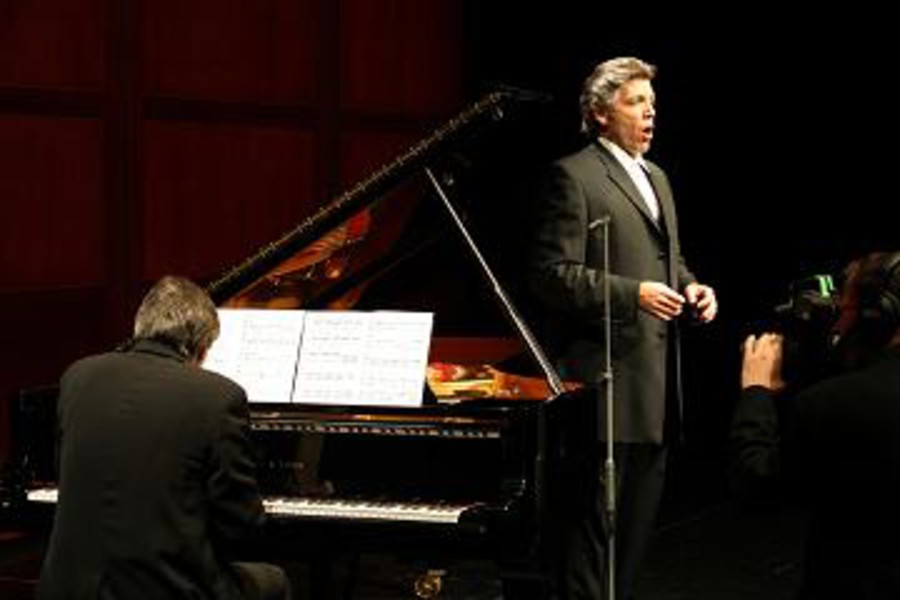
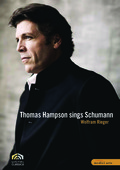
If there is one genre of music which baritone Thomas Hampson is
exceptionally passionate about, it is the lied. To Hampson, song and
singing are "the diary of our existence" and he has invested a great
amount of time, work and love to luring this genre out of the shadow of
the more spectacular opera. One composer he particularly cherishes is
Robert Schumann. Hampson begins this Schumann recital, recorded at
Munich's Prinzregententheater with Wolfram Rieger at the piano, with the
cycle Zwölf Gedichte op. 35 on poems by Justinus Kerner.
The second part of the recital is devoted to the original version of the
popular Dichterliebe op. 48. While Hampson was preparing his first
performance of the cycle based on poems by Heinrich Heine, he consulted
the composer's manuscript, only to find that the original cycle of 1840
was a completely distinctive work containing many musical and textual
differences. Among the most notable differences was the presence of four
songs that were omitted from the later cycle. These works - "Dein
Angesicht so lieb und schön," "Lehn deine Wang an meine Wang," "Es
leuchtet meine Liebe" and "Mein Wagen rollet langsam" - are featured here
as first-ever recordings of these rediscovered works.
Today's baritone landscape would be barren without Thomas Hampson. He has
provided unforgettable accounts of the title roles in Don Giovanni, Il
barbiere di Siviglia, Macbeth, Simon Boccanegra, Eugene Onegin, Massenet's
Werther and Busoni's Doktor Faust, and he added a unique warmth to the
role of Germont père in the celebrated Netrebko-Villazón "La Traviata" of
the Salzburg Festival documented by UNITEL CLASSICA. Through his encounter
with Leonard Bernstein, he became a leading interpreter of the music of
Gustav Mahler and recorded several Mahler cycles for UNITEL CLASSICA.